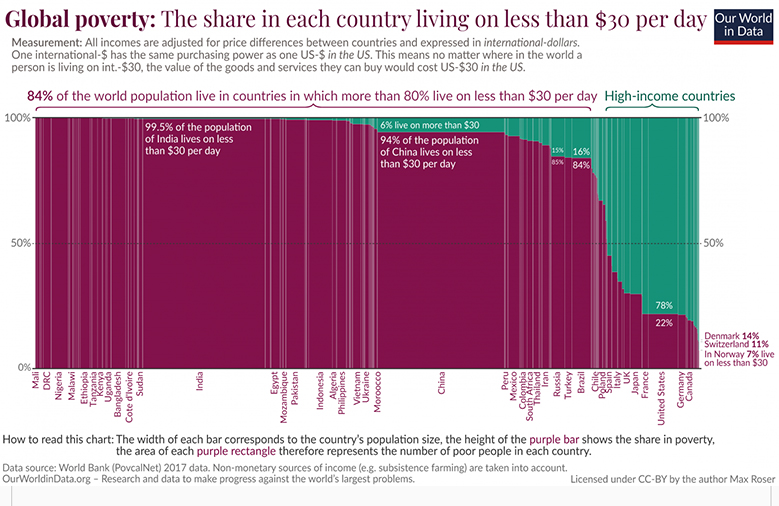
How much economic growth is necessary to reduce global poverty substantially?
Billions of people in the world are living in poverty. Adjusted for the purchasing power in each country, 85% of the world population live on less than $30 per day.
In an earlier post I said that ‘if we want global poverty to decline substantially then the economies that are home to the poorest billions of people need to grow.’ In this post I want to make this statement more concrete. I will look at the depth of global poverty today to get a quantitative sense of just how much the global income distribution would need to change to reduce global poverty substantially.
As a starting point for the discussion I will consider the inequality of incomes in the world today and think through a scenario that would allow the maximal reduction of global poverty under minimal global aggregate income growth. After calculating the minimum aggregate growth that is required to reduce global poverty substantially I will consider in which ways a possible more realistic scenario of the future might differ from the minimum scenario.
In an earlier text I asked who is considered poor in a high-income country. Based on existing national poverty lines – but also the size of social care payouts, a proposal for Universal Basic Income, and survey results – I found that $30 per day is, very approximately, the level below which people are considered poor in high-income countries.
One of the most important insights of economics is that people live in poverty not because of who they are, but because of where they are. A person’s knowledge, their skills, and how hard they work all matter for whether they are poor or not – but all these personal factors together matter less than the one factor that is entirely outside of a person’s control: whether the place they happen to be born into has a large, productive economy or not.
The comparison of a high-income country like Denmark and a much poorer country like Ethiopia makes clear just how important this aspect is. A person living in Denmark has a chance of 86% that they are not poor. A person who happens to be born into a country where the average income is low is almost certainly living in poverty. In Ethiopia more than 99% of the population live on less than $30 per day. This is why a rise in the average level of income in a country – economic growth – is so crucial for reducing poverty.
